

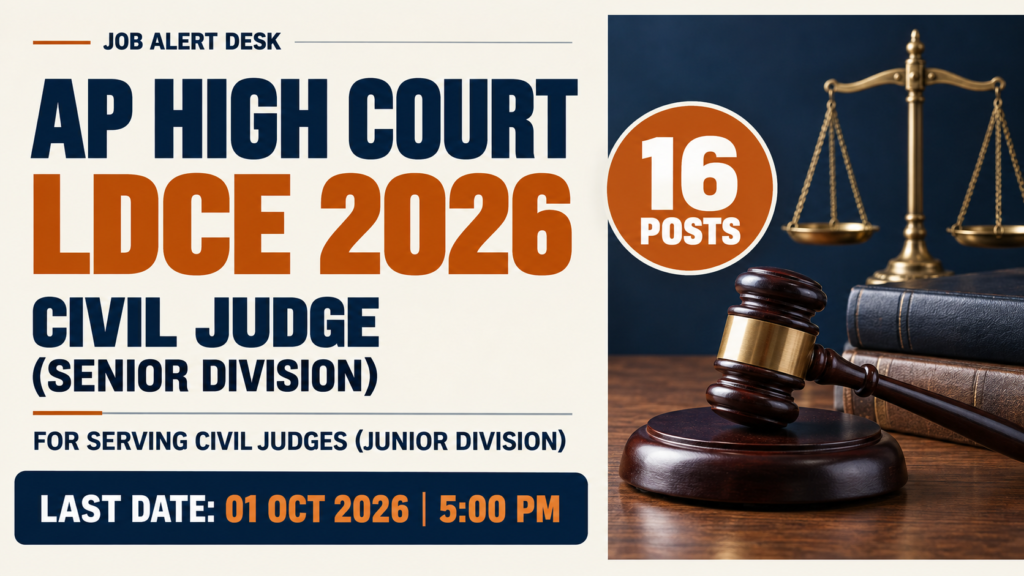
AP High Court LDCE 2026 is a departmental promotion opportunity for eligible judicial officers in Andhra Pradesh. The High Court of Andhra Pradesh at Amaravati has notified 16 Civil Judge (Senior Division) vacancies through accelerated promotion by a Limited Departmental Competitive Examination, commonly called LDCE.
The notification, R.O.C. No. 366/2026-RC, dated 17 September 2026, is meant for serving Civil Judges (Junior Division) in the Andhra Pradesh State Judicial Service who have completed at least three years of service in that cadre by 31 March 2026. Fresh law graduates and practising advocates who do not meet this service requirement cannot apply under this particular notification.
Applications, with the prescribed enclosures, must reach the office of the concerned Principal District Judge by 5:00 PM on 1 October 2026. The notified pay scale is Rs. 1,11,000 to Rs. 1,63,030. These details are set out in the official notification and application forms.
For an officer balancing court work with exam preparation, the most useful starting point is a clear view of eligibility, paperwork and qualifying marks. This guide brings those details together and explains the points that are easy to overlook.
AP High Court LDCE 2026 Overview
| Particular | Details |
|---|---|
| Recruiting authority | High Court of Andhra Pradesh at Amaravati |
| Notification number | R.O.C. No. 366/2026-RC |
| Notification date | 17 September 2026 |
| Post | Civil Judge (Senior Division) |
| Total vacancies | 16 |
| Recruitment route | Accelerated promotion through LDCE |
| Eligible cadre | Civil Judge (Junior Division), Andhra Pradesh State Judicial Service |
| Required service | At least three years by 31 March 2026 |
| Application method | Prescribed physical application with enclosures |
| Submission office | Concerned Principal District Judge’s office |
| Last date and time | 1 October 2026, 5:00 PM |
| Pay scale | Rs. 1,11,000-Rs. 1,63,030 |
| Selection stages | Screening test if conducted, written examination and viva voce |
| Official website | High Court of Andhra Pradesh |
The notification states that the Andhra Pradesh State Judicial (Service and Cadre) Rules, 2026 apply to this process. Applicants should read the complete notification alongside this explanation before preparing their application.
Important Dates and Service Cut-off
| Event | Date or status |
|---|---|
| Notification issued | 17 September 2026 |
| Cut-off for three years of qualifying service | 31 March 2026 |
| Date for reporting age in the application form | 1 September 2026 |
| Application submission deadline | 1 October 2026, 5:00 PM |
| Screening test date, if conducted | Not specified in this notification |
| Written examination date | Not specified in this notification |
| Viva voce date | Not specified in this notification |
The service cut-off, age-reporting date and application deadline serve different purposes. Do not calculate the required three years of service up to October simply because applications close in October.
The prescribed form asks for age as on 1 September 2026. That field does not, by itself, establish a minimum or maximum age limit. This notification does not state a separate numerical age range in its eligibility section.
AP High Court Civil Judge Recruitment 2026: Vacancy Details
The 16 vacancies are distributed as follows:
| Category | Vacancies |
|---|---|
| OC | 12 |
| SC Group-I | 1 |
| SC Group-II | 1 |
| SC Group-III | 1 |
| ST | 1 |
| Total | 16 |
Applicants seeking SC or ST reservation must provide the community certificate required by the notification. The certificate must identify the relevant group classification where applicable.
The High Court reserves the right to change the number of vacancies or cancel the notification. The published total should therefore be read together with any subsequent official notices.
The fee table later in this guide includes EWS, BC and persons with benchmark disabilities. Those fee categories do not create additional reserved vacancy categories beyond the distribution shown above.
AP High Court LDCE 2026 Eligibility
The central eligibility requirement is service in the specified judicial cadre. An applicant must have completed not less than three years as a Civil Judge (Junior Division) in the Andhra Pradesh State Judicial Service by 31 March 2026.
Holding a law degree alone does not satisfy this condition. Similarly, three years of legal practice cannot be substituted for three years of service in the named cadre under this notification.
Applicants should check the appointment date and the qualifying service recorded by the competent authority. The application asks for both the date of appointment and the length of service as on the prescribed cut-off. These entries should agree with the supporting records.
Disqualifications to check before applying
The notification excludes an officer facing disciplinary charges or undergoing punishment for irregularities in the discharge of duties. It also excludes an officer found to be of doubtful integrity in any year.
The application form separately asks whether the applicant is facing a disciplinary enquiry, has undergone punishment or is undergoing punishment, and requires details where relevant. Complete that disclosure accurately; do not treat the shorter eligibility summary as a reason to omit information requested by the form.
The High Court’s decision on eligibility for the examination and viva voce is final. See pages 2-4 of the notification for the eligibility and selection provisions.
Pay Scale and Application Fee
The Civil Judge (Senior Division) post carries a notified pay scale of Rs. 1,11,000-Rs. 1,63,030. This is the pay scale printed in the notification, rather than a guaranteed take-home amount. The document does not give an individual calculation of allowances, deductions or net salary.
The application and examination fee is:
| Applicant category | Fee |
|---|---|
| Open Category / EWS / BC | Rs. 1,000 |
| SC / ST / Persons with Benchmark Disabilities | Rs. 500 |
Payment must be made by Demand Draft in favour of:

Registrar (Recruitment), High Court of Andhra Pradesh, Nelapadu, Amaravati
The notification specifies this payment method. It does not provide a UPI, card or net-banking payment route for this application. Before obtaining the draft, check the amount applicable to your category and copy the payee name carefully from the fee instructions on page 6.
Documents Required with the Application
Prepare the application file early enough to obtain the necessary certificates and attestations. The notification and appended forms require the following:
- Completed and signed application in the prescribed format.
- Attested copy of the date-of-birth certificate or SSC certificate.
- Attested copy of the law degree and other relevant certificates.
- Service certificate in the Civil Judge (Junior Division) cadre, issued by the competent authority.
- Appointment order as Civil Judge (Junior Division).
- Attested community certificate for applicants claiming SC or ST reservation, showing the required group classification.
- Demand Draft for the applicable fee.
- Hall ticket-cum-identity card forms, including the required original and duplicate copies.
- Recent passport-size photographs and the attestations specified in the forms.
The hall ticket-cum-identity card formats require the candidate’s photograph and signature to be attested by the concerned Unit Head or Principal District Judge. Follow the signing instruction printed on the form.
Keep the original certificates ready for the viva voce. The notification says that failure to produce a required original at verification will result in rejection of candidature.
AP High Court LDCE Application Form: How to Apply
The AP High Court LDCE 2026 application is a physical submission using the pro forma attached to the notification. Downloading the PDF is only the first step.
- Download the complete notification. Read the eligibility, fee, examination and submission instructions before filling the form.
- Use the appended application pro forma. Enter your name, personal details, category, date of birth, educational qualifications and correspondence information carefully.
- Check the service entries. Provide your appointment date and service length up to 31 March 2026, supported by the required certificate.
- Complete the disciplinary disclosure. Supply any details requested by the form and sign and date the application.
- Arrange the Demand Draft. Use the prescribed category-wise fee and exact payee name.
- Prepare the enclosures and identity-card forms. Complete the candidate fields and obtain the specified photograph and signature attestations.
- Review the entire file. Check that the signature, certificates, appointment order, fee and required copies are present.
- Submit within the deadline. Deliver the complete application to the concerned Principal District Judge’s office by 5:00 PM on 1 October 2026.
Do not assume that the Demand Draft payee is also the place where you should submit the application. The notification names the Registrar as the payee and the concerned Principal District Judge’s office as the submission point.
As a practical record-keeping step, retain a copy of the completed application and enclosures. This is a preparation suggestion, not an additional eligibility condition. Late, unsigned, incomplete or improperly filled applications are liable to rejection.
AP High Court LDCE 2026 Selection Process
The selection process provides for a screening test where necessary, a written examination and a viva voce. The screening test depends on the number of applications received; it should not be described as an already confirmed examination stage.
Screening test, if conducted
| Component | Details |
|---|---|
| Mode | Computer-based test |
| Questions | 100 multiple-choice questions |
| Maximum marks | 100 |
| Duration | Two hours |
| Minimum screening marks | 40% |
| Shortlisting ratio for written examination | 1:10 against available vacancies |
Candidates with identical marks at the relevant category cut-off are covered by the tie provision in the notification. Scoring 40% is a qualifying requirement; it does not guarantee a place in the written examination when the shortlisting ratio applies.
Screening marks are used only to shortlist candidates. They are excluded from final merit. The notification does not state a negative-marking rule, so applicants should check the later examination instructions instead of assuming one.
Written examination pattern
| Paper | Subject | Marks | Duration |
|---|---|---|---|
| Paper I | Civil Laws | 100 | Three hours |
| Paper II | Criminal Laws | 100 | Three hours |
| Paper III | English: Translation and Essay Writing | 100 | Three hours |
Answers must be written in English except where the translation exercise requires Telugu.
Paper III has two parts. Translation carries 40 marks and includes English-to-Telugu and Telugu-to-English passages. Essay writing carries 60 marks, with essays restricted to legal subjects.
Candidates must score at least 40% in each part of Paper III. That corresponds to at least 16 out of 40 in translation and 24 out of 60 in essay writing. Passing the paper requires meeting each part’s threshold separately.
Paper III is qualifying. Its marks are excluded when calculating eligibility for viva voce and final selection, although the paper itself must be passed.
Qualifying Marks, Viva Voce and Final Merit
The main thresholds in AP High Court LDCE 2026 are:
| Requirement | Minimum or rule |
|---|---|
| Paper I | 55% |
| Paper II | 55% |
| Written aggregate for viva voce eligibility | 60%, with Paper III excluded from the merit calculation |
| Paper III translation | 40% of that part |
| Paper III essay writing | 40% of that part |
| Viva voce maximum | 50 marks |
| Viva voce shortlisting | 1:3 against available vacancies, subject to ties |
| Final written-plus-viva aggregate | At least 60% |
The per-paper and aggregate conditions work together. For example, 55 marks in each of Papers I and II meets the individual minimums but produces only 110 out of 200, or 55%. It does not meet the 60% written aggregate requirement.
Reading the merit provisions together, Papers I and II contribute 200 marks and the viva voce contributes 50, giving a 250-mark merit total. A 60% final aggregate is therefore 150 out of 250. This arithmetic explains the stated thresholds; minimum qualification still does not guarantee selection within the available vacancies.
If candidates have equal written-plus-viva marks, the notification gives preference first to the older candidate, then to higher educational qualification if age is also tied, and finally to higher marks in the prescribed qualification if the tie remains.
Absence from the viva voce results in disqualification. No TA or DA is payable for attending the screening test, written examination or viva voce.

AP High Court LDCE Syllabus
The syllabus covers Civil Laws, Criminal Laws and the English exercises described above. The following statutory subjects are listed on pages 5-6 of the notification.
Civil Laws
- Code of Civil Procedure, 1908.
- Indian Succession Act, 1925.
- Right to Fair Compensation and Transparency in Land Acquisition, Rehabilitation and Resettlement Act, 2013.
- Hindu Marriage Act, 1955.
- Hindu Succession Act, 1956.
- Specific Relief Act, 1963.
- Arbitration and Conciliation Act, 1996.
- A.P. Municipalities Act, 1965.
- Civil Rules of Practice.
- A.P. Civil Courts Act, 1972.
- Indian Contract Act, 1872.
- Indian Easements Act, 1882.
- Limitation Act, 1963.
- Transfer of Property Act, 1882.
- Registration Act, 1908, and Stamp Act, 1899.
- A.P. Land Encroachment Act, 1905.
- Indian Evidence Act, 1872.
- Bharatiya Sakshya Adhiniyam, 2023.
Criminal Laws
- Code of Criminal Procedure, 1973.
- Indian Evidence Act, 1872.
- Indian Penal Code, 1860.
- Bharatiya Nagarik Suraksha Sanhita, 2023.
- Bharatiya Sakshya Adhiniyam, 2023.
- Bharatiya Nyaya Sanhita, 2023.
- Criminal Rules of Practice.
- Prize Chits and Money Circulation Schemes (Banning) Act, 1978.
- Negotiable Instruments Act, 1881, Sections 138-148.
- Protection of Women from Domestic Violence Act, 2005.
The syllabus expressly includes the older criminal enactments and the newer criminal laws. Prepare from the actual list rather than replacing one set with the other based on a general exam-preparation article.
Preparation and Application Mistakes to Avoid
With regular court responsibilities, a focused preparation plan is more manageable than an unrealistic timetable. Start by checking the official syllabus against your revision notes, then identify the subjects that need the most attention.
Practise Civil Law and Criminal Law answers within the three-hour paper limit. Set aside separate time for translation in both directions and essays on legal subjects. A qualifying paper can still prevent further progress if its individual-part requirements are missed.
These are practical study suggestions, not additional requirements announced by the High Court. They should fit around the candidate’s responsibilities and the examination schedule when it is issued.
For the application itself, pay particular attention to:
- Using the correct service cut-off instead of the closing date.
- Reporting the age requested in the form without inventing an age-limit rule.
- Attaching the appointment order as well as the service certificate.
- Obtaining the specified attestations on photographs and identity-card forms.
- Submitting to the correct office before the stated time.
- Checking official updates after submission instead of treating the downloaded notification as the final update for every stage.
Official Notification, Forms and Updates
| Resource | Link |
|---|---|
| Notification, application pro forma and identity-card formats | Download the official 12-page PDF |
| Recruitment notices for 2026 | AP High Court recruitment page |
| Court website | High Court of Andhra Pradesh |
The application pro forma appears on pages 7-8. Hall ticket-cum-identity card formats for the screening test and written examination appear on pages 9-12. Complete only the candidate fields and follow the instructions for attestation and official entries.
The notification directs applicants to monitor the court website for all stages and results. Examination dates and later instructions should be taken from those updates when available.
AP High Court LDCE 2026 FAQs
Who can apply for AP High Court LDCE 2026?
Eligible Civil Judges (Junior Division) in the Andhra Pradesh State Judicial Service with at least three years of service in that cadre by 31 March 2026 can apply, subject to the notification’s other conditions.
Can a fresh LLB graduate or practising advocate apply?
This notification requires service as a Civil Judge (Junior Division) in the specified state judicial service. An LLB qualification or advocacy experience alone does not satisfy that requirement.
What is the last date to submit the application?
The complete application must be submitted to the concerned Principal District Judge’s office by 5:00 PM on 1 October 2026. Applications received after the deadline are liable to rejection.
Is there an online application or payment link?
The notification prescribes a physical application with enclosures and payment by Demand Draft. It does not provide an online submission or online fee-payment route for this process.
Is the screening test compulsory for everyone?
Conducting a screening test depends on the number of applications received. If conducted, it is a shortlisting stage with 100 questions for 100 marks and a two-hour duration.
Do English paper marks count towards final selection?
Paper III must be passed with 40% in each part, but its marks are excluded from the merit calculation. Final merit uses Papers I and II and the viva voce, subject to the applicable thresholds and selection rules.
Has the written examination date been announced in this PDF?
The supplied notification does not specify the written examination date. Applicants should follow the official recruitment page for the schedule, hall-ticket instructions and subsequent notices.
Source note: This guide explains Notification R.O.C. No. 366/2026-RC dated 17 September 2026, reviewed on 18 September 2026. Job Alert Desk is an independent information website. The official notification and subsequent High Court instructions govern eligibility, applications and selection.
For More Updates Follow Clickhere