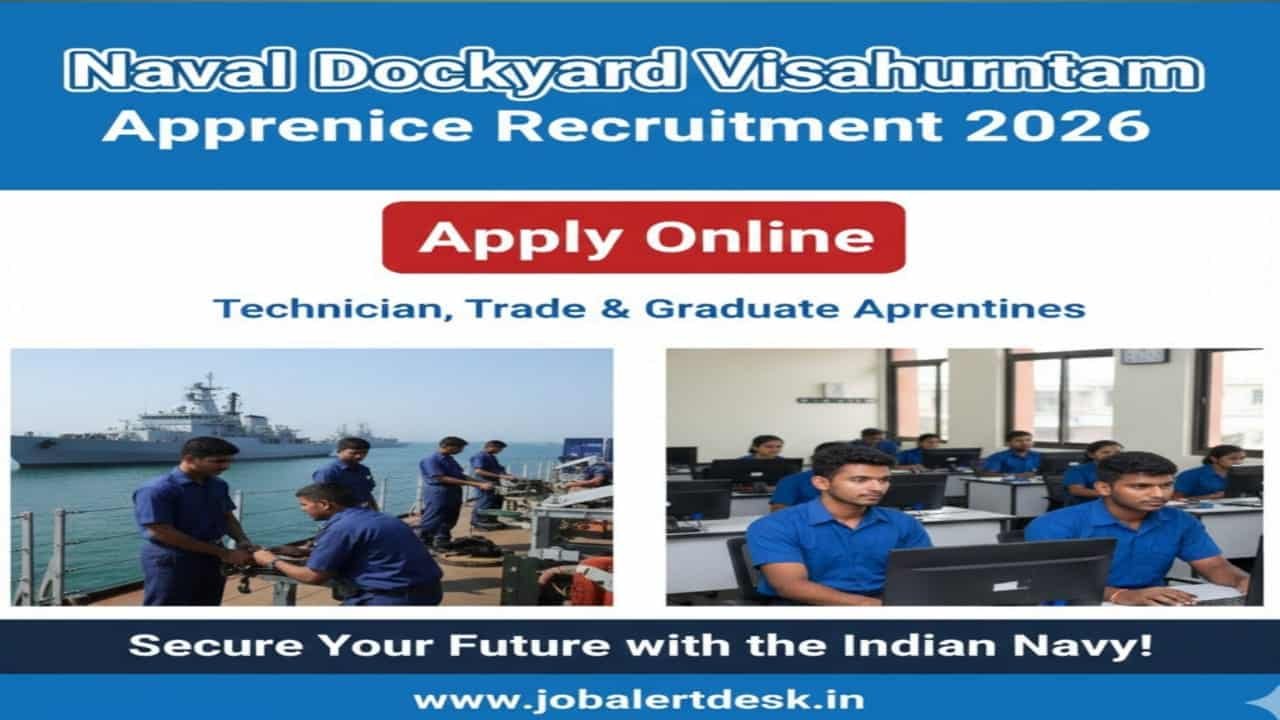
Naval Dockyard Visakhapatnam Apprentice
A fresh announcement about the enrollment of Designated Trade Apprentices for the 2026–2027 batch at the Naval Dockyard Apprentices School (DAS), Naval Dockyard Visakhapatnam, has been announced by the Ministry of Defence (Navy). Indian nationals having ITI qualifications are encouraged to apply for a one-year apprenticeship program under the Apprentices Act of 1961. ITI candidates have a great chance to gain practical experience in technical trades in a Naval Dockyard setting through this program.
Naval Dockyard Visakhapatnam Apprentice Job Overview
- Mechanic Diesel
- Machinist
- Electrician
- Pipe Fitter
- Foundryman
- Instrument Mechanic
- Electronics Mechanic
- Welder (Gas & Electric)
- Computer Operator & Programming Assistant, etc.
Naval Dockyard Visakhapatnam Apprentice Job Description
No Upper Age restriction for Apprentices: The Naval Dockyard adheres to the Ministry of Skill Development’s rules for this cycle of apprenticeship, which explicitly specify that there is no upper age restriction for candidates seeking apprenticeship training. Candidates of any age who are physically and educationally eligible may apply without any limitations thanks to our open policy. Regardless of age, the strategy encourages broader involvement and allows qualified ITI applicants to advance their technical skills. In order to ensure equitable chances, the notice affirms this waiver based on the official MSDE memorandum published on December 20, 2021.
Minimum Age Requirements for All Trades: There is a minimum age requirement for safety and training requirements, but there is no upper restriction. Under the Apprentices Act of 1961, candidates must be at least 14 years old to enroll in apprenticeship programs. This minimal age guarantees that a candidate is old enough to receive technical training in workshop settings and has finished their basic education. Young candidates are shielded from job exposure that may entail machinery, tools, or workshop safety procedures by this legally established norm. Registration for any trade is not available to applicants under the age limit.
Minimum Age for dangerous Trades: Welding, electrical settings, heavy metal handling, and industrial machinery are some of the dangerous jobs that fall under this category. The minimum age requirement for these categories is eighteen. This illness is particularly associated with dangerous jobs where using equipment calls on good motor coordination and the ability to make safe decisions. In transactions involving heat, electric current, pressure tools, and chemical exposure, the regulation seeks to lower risk. The notification emphasizes a distinct age difference between general and hazardous trade admissions, bringing this rule into compliance with the Apprentices Act.
Date-Based Eligibility Rule: The Naval Dockyard announcement specifies precise deadlines for eligibility. The candidate must fulfill the minimum age requirement for non-hazardous trades by being born on or before May 02, 2012. The candidate must be born on or before May 02, 2008, in order to be considered for hazardous trades. These precise dates eliminate uncertainty and offer clarity during document verification. In order to guarantee that candidates are of legal age on the initiation date, the dates are determined depending on the training start period. During form examination, these cut-offs are crucial.
Date of Birth Verification: Candidates must confirm that their SSC certificate and Aadhaar date of birth match. Due to the stringent age requirements for hazardous industries, any discrepancy might result in the rejection of an application. If there are discrepancies, the notice advises applicants to update their Aadhaar information. This shows that the date of birth is a crucial eligibility requirement that affects all aspects of reservation, selection, and trade eligibility. Verifying one’s birthdate helps prevent future conflicts during the test or document verification stages. Processing is made easier by keeping precise records.
Legal Basis for Age Requirements: The Apprentices Act of 1961, which establishes minimum age requirements to protect young trainees, governs the age requirements, which are not arbitrary. Additionally, it relates to the Apprenticeship Rules of 1992, including any current revisions. Employers are encouraged to increase enrollment by removing the upper age limit through the Ministry of Skill Development’s circulars. This framework, which the Naval Dockyard adheres to, guarantees uniformity for apprenticeship age standards at the national level. The regulations are created with equitable learning opportunities, training exposure, and safety in mind.
No Age Relaxation Required: Since there is no maximum age restriction, categories like SC, ST, OBC, PWD, and dependents of the Armed Forces do not require separate age relaxations. All individuals who satisfy the minimum age requirements are eligible to apply, regardless of their community or reserve group. Because just the lowest age restriction is relevant, this simplifies the application procedure. The application is still legitimate even if the candidate is older. As a result, the Naval Dockyard offers applicants who were previously denied chances because of upper age restrictions an inclusive route.
Age and Trade Safety Requirements: The minimum age requirement depends on the type of training and workshop arrangements. The 18-year limit is upheld in trades requiring cognitive maturity, such as foundry operations, heavy machinery, pressure tools, and electrical systems. Painting, fitting, and computer help are examples of non-hazardous vocations that only need a 14-year minimum. The age structure lowers workshop hazards and safeguards apprentices. Widening eligibility is not as important as safety, particularly in transactions that call for extreme technical care. Age is defined in the notice according to trading risk levels.
Proof Needed for Verification: During the document verification phase, applicants are required to present their actual SSC certificate, which contains the legally recognized birthdate. For age consideration, no other unofficial document will be acceptable. Additionally, the SSC record and the Aadhaar card must match. The medical check upon training entrance verifies physical maturity in accordance with age eligibility. Even after passing the test, candidates who are unable to provide proof of their age will be eliminated. Age evidence is therefore important at several points in the selecting process.
Age Rules and Training Schedule: The training start date, which is set for May 02, 2026, is the basis for the age eligibility dates. When training starts, the computation guarantees that applicants are at least 14 or 18 years old. This method keeps minors out of live workshop sessions. Exam dates, medical examinations, and reporting obligations are all synchronized with the schedule. A applicant cannot be accepted even if they become eligible soon after the deadline. In addition to preventing mid-cycle eligibility issues, the definite date guarantees uniform enrollment.
Educational Qualification:
Required Academic Qualification: In order to be eligible for the Naval Dockyard Visakhapatnam apprenticeship batch, candidates must possess the basic academic qualification of SSC/Matric/Standard X, completed from an accredited board. According to the notification, the minimum required aggregate score in SSC is 50%, calculated based on total marks. This guarantees that each apprentice has fundamental academic knowledge in important subjects like science and mathematics, which are crucial for industrial training and technical learning. No equivalent qualification is accepted.
ITI Certification Requirement: A candidate must hold a recognized ITI qualification under NCVT or SCVT programs in addition to SSC. In ITI trade, a minimum aggregate score of 65% is necessary, and this number is consistent across all categories. The apprenticeship trade must coincide with the ITI trade. An ITI certificate attests to a candidate’s completion of organized technical instruction and readiness for practical work. At the Dockyard, sophisticated industrial processes are learned through ITI education.
ITI Trade Relevance: The announcement makes it very clear that each apprenticeship trade given is exclusively open to certain ITI trades. Marine Engine Fitter, for instance, is mapped to Mechanic Diesel; Central AC Plant Mechanic is mapped to Refrigeration; and Shipwright Wood is mapped to Carpenter. Only candidates whose ITI trade corresponds with the specified Naval Dockyard trade will be taken into consideration for the apprenticeship selection. During the document screening process, applications with unrelated trades will be rejected.
Scorecard Requirement: Because percentages are used for merit ranking, the Naval Dockyard stresses that both SSC and ITI certificates must have marks or grades. The application will not be approved if an applicant produces a certificate that lacks marks, grade points, or percentage verification. Clear score records from both exams are necessary for eligibility. This regulation guarantees openness in the shortlisting process, where academic evaluation is weighted 70:30 between SSC and ITI scores, respectively.
NCVT and SCVT Recognition: Only ITI credentials from institutions recognized by the National Council for Vocational Training (NCVT) or the State Council for Vocational Training (SCVT) are accepted under the eligibility requirements. Certificates of private, unacknowledged, or temporary training are ineligible. In order to guarantee that applicants entering the apprenticeship get training in fundamental trade skills, NCVT/SCVT institutions adhere to controlled workshops and established industrial curricula. These certifications attest to the trainees’ compliance with the national skill requirements needed for defense-level instruction.
No Acceptance Without Documents: During the document verification phase, candidates must provide appropriate academic evidence, such as actual SSC and ITI marksheets. Even if an applicant is shortlisted, the selection panel will reject their application if they do not have proper documents. While filling up their profile on the Apprenticeship Portal, candidates are also instructed by the notice to upload supporting documentation. Only authentic profiles are taken into account for final merit and enrollment thanks to this twofold verification procedure.
Single Qualification for the Trade: According to the Naval Dockyard regulations, a trade may only take into account one ITI qualification. The applicable trade that corresponds with the apprenticeship will be taken into consideration if an applicant holds several ITI certifications in other trades. The applicant cannot use distinct ITI qualifications to pursue more than one trade option. This prevents misunderstanding during seat allocation and maintains the application system’s cleanliness. The trade that best suits their strongest ITI certification must be carefully chosen by applicants.
Previous Apprenticeship Restriction: Applicants are not permitted to reapply if they have previously completed apprenticeship training in the same trade under any organization. This regulation guarantees chances for new applicants and avoids duplication of government-funded training. It is applicable under the Apprentices Act of 1961, which emphasizes that industry diversification is not enhanced by repetition in the same trade. For the Naval Dockyard 2026–2027 batch, only first-time apprentices in a specific trade will be taken into consideration.
Digital Validation via Portal: The Apprenticeship India online portal is used to authenticate educational records. To do this, aspirants must submit their SSC and ITI information and confirm their Aadhaar. The candidate profile is automatically created by the platform and needs to correspond with the actual papers that are provided to the Dockyard. Rejection might result from entering inaccurate marks or insufficient information. Errors are decreased and the recruiting panel has access to clean digital data thanks to the portal-based documentation. Fair and transparent merit evaluation is also made possible by the online approach. Visakhapatnam Naval Dockyard
Importance of Educational Scores: SSC and ITI scores account for 70% and 30% of the shortlisting process for the written test, respectively. Strong technical scores are encouraged and steady academic success is rewarded under this scheme. Academic background is still essential for obtaining a hall pass, even if the ultimate selection is determined by a written exam. In order to increase their chances of being admitted into the defense technical training system, candidates must make sure their credentials are correct, pertinent, and fulfill minimal score standards. Visakhapatnam Naval Dockyard
Application Fee
No Application Fee Required: The notice from the Naval Dockyard Visakhapatnam makes it very clear that there is no application fee for filing an apprenticeship application. The whole application and selection procedure is free, including registering on the Apprenticeship Portal, submitting paperwork, and receiving a hall pass. This guarantees fair participation for applicants from all socioeconomic backgrounds, particularly those from low-income rural areas.
There are no fees at any point in the Naval Dockyard apprenticeship selection process, in contrast to many competitive tests where candidates must pay examination fees. Online registration, offline submission, written test appearance, and medical examination are all free of charge. Applicants are cautioned in the announcement not to pay anyone or middlemen. Demands for money are prohibited by law and are not approved by the Apprentices School. The Apprentices Act provides complete government backing for the process. Visakhapatnam Naval Dockyard
Protection Against Fraud: The government has issued a strong warning to candidates to steer clear of middlemen or brokers who claim to be able to win seats in exchange for cash. The letter emphasizes that applicants shouldn’t fall for scam and that no money has to be given to anybody. It promotes using the official Naval Dockyard email address included in the warning to report such instances immediately. This preserves recruiting openness and shields candidates from financial abuse. Confidentiality is ensured, however anonymous complaints are not accepted. Visakhapatnam Naval Dockyard
Self-Paid Envelope Requirement: The candidate must send a self-addressed envelope with ₹55/-postal stamps, even though there is no charge. The hall pass is sent by Speed Post using this envelope. This is only a postal requirement to guarantee that candidates receive their hall pass securely and at their address; it is not an application cost. Since hall passes are not given online, the applicant is responsible for paying this minor mail fee. The application material has to be contained with the mail. Visakhapatnam Naval Dockyard
Goal of the No-Fee Policy: The government’s goal to promote young technical skill development without financial obstacles is reflected in the no-fee structure. The training is in line with national skill development initiatives, and the Naval Dockyard is run by the Ministry of Defense. More ITI students can take part in defense-sector training when fee constraints are eliminated. It helps achieve the objective of increasing the number of skilled experts for industrial and naval applications nationwide. Visakhapatnam Naval Dockyard
Equality for All groups: The issue of fee reduction for reserved groups such as SC, ST, OBC, PWD, or Ex-Servicemen does not come up because there is no application cost. Every candidate is eligible for the same free benefit. Full transparency and clarity about fee payment regulations are ensured by this consistent approach. The Naval Dockyard method completely eliminates the financial barrier that prevents many students from applying for government training. Regardless of socioeconomic background, it encourages equitable access.
Written test Without Fees: There is no test cost for the written exam, which is the main criterion for merit-based selection. According to the advertisement, selected students can take the test without paying and will receive hall passes depending on their SSC and ITI merit. This assists worthy young technicians who would otherwise be discouraged by test fees. Travel is the only expense a candidate may have because hotel and transportation are not covered. Visakhapatnam Naval Dockyard
No Indirect or Hidden Fees: The company makes it clear that there are no service charges or hidden costs involved in any part of the procedure. Financial transactions for document verification, admission confirmation, or merit list placement have been discouraged by the training institute. Additionally, the regulations caution that bribery and canvassing will result in disqualification. By concentrating solely on merit and eligibility requirements, Naval Dockyard guarantees a hygienic and corrupt-free selection process. Visakhapatnam Naval Dockyard
Costs Outside of the Selection: Although the institution does not charge a fee, candidates are responsible for covering their own costs throughout the selection process, including lodging, meals, and travel for examinations or medical testing. The announcement makes it clear that the government will not cover travel expenses or offer boarding or accommodation. Because of this, it is crucial for applicants from far-off places to budget for their trip expenses. Male apprentices from outside the area may be eligible for restricted hostel accommodations once chosen.
Reporting Suspected Fee demands: Any unlawful fee demands made by unauthorized people can be reported using the Naval Dockyard’s official email channel. The Officer-in-Charge may receive complaints along with supporting documentation. This preserves the legitimacy of the hiring process and fosters trust. Additionally, it gives candidates the authority to take action against fraud. The administration guarantees the complaint total secrecy. This feature shows that the zero-fee policy is both official and subject to strict compliance monitoring.
Important Dates
| Activity/Event | Date |
|---|---|
| Last date for receiving applications | 02 January 2026 |
| Written Examination | 22 March 2026 (AM) |
| Declaration of Exam Results | 25 March 2026 (PM) |
| Document Verification | 30 March 2026 |
| Medical Examination Starts | 31 March 2026 onwards |
| Training Commencement Date | 02 May 2026 |
Exam Pattern & Syllabus
Exam Format Overview: There are 100 objective multiple-choice questions in this OMR-based test. One mark is awarded for each question, for a total score of 100. The test lasts two hours in total, so applicants have plenty of time to provide appropriate answers. To ensure uniformity across all trades and categories, the exam is administered solely in English. Incorrect responses are not penalized.
Subject-Wise Question Distribution: There are three main sections to the written exam: General Knowledge (30 questions), General Science (35 questions), and Mathematics (35 questions). The fundamental information needed for practical industrial training is included in this distribution. Numerical aptitude and logical thinking are tested in mathematics. Physics, chemistry, and everyday scientific ideas are assessed in general science. Basic information, national concerns, and environmental awareness are all measured by general knowledge.
Mathematics Syllabus: SSC-level subjects, including arithmetic operations, percentages, ratio-proportion, time and effort, averages, fundamental algebraic expressions, geometry of forms, square roots, rudimentary trigonometry, and data interpretation, are the main emphasis of mathematics on the test. Testing a candidate’s aptitude for handling practical numerical issues is the goal. Mathematical thinking aids in precise measurements and calculations during training activities in a variety of mechanical vocations as apprentices work on technical tasks in workshops. Visakhapatnam Naval Dockyard
General Science Syllabus: Basic physics, chemistry, and biological concepts covered in school provide the basis for general science questions. Motion and force, energy forms, the fundamentals of electricity, heat and temperature, metals and non-metals, mixtures and compounds, acids and bases, plant and human physiology, ecology, and practical lab awareness are all covered in the curriculum. These subjects aid in comprehension of the electrical and mechanical systems, material behavior, and workplace safety that are encountered throughout industrial apprenticeship practice.
General Knowledge Syllabus: The GK part includes questions about current affairs, national events, basic history, geography, information about the Indian constitution, well-known individuals, and fundamental economics. Inquiries about advancements in science and technology, the Indian armed forces, and the overall environment may also be included. Since the Ministry of Defense oversees the apprenticeship, knowledge of national institutions and structures is deemed crucial. The questions are objective and may be answered using a combination of normal reading habits and basic school knowledge.
Exam Difficulty Level: Matric (10th standard) academic levels are reflected in the exam level. The straightforward questions are intended to assess applicants’ basic knowledge rather than their high technical proficiency. The test does not cover ITI-technical trade questions because the ultimate skill development occurs during the apprenticeship. Only the basic knowledge needed to gain throughout the training session is tested on this exam. Visakhapatnam Naval Dockyard
test-Based Merit List: While SSC and ITI scores are used in a 70:30 ratio for test shortlisting, only written exam scores are used to create the final merit list. greater category-wise ranking is correlated with greater exam results. When two applicants get identical scores, the older candidate is given preference based on their date of birth. Names are sorted alphabetically according to the SSC certificate if they are still tied.
Exam Importance: The written exam serves as the first step in the selection process. The results of the written test determine who will move forward with the final appointment, medical examination, and document verification. Since there will be no interviews, candidates should properly prepare in fundamental topics. By measuring candidates’ logical thinking abilities and standardized school-level knowledge, the exam guarantees equal chance for all applicants, regardless of their experience. Visakhapatnam Naval Dockyard
Exam Day Instructions: Candidates are required to bring the original hall pass, a pen for marking the OMR sheet, and identification verification, such as Aadhaar, on exam day. The examination facility information, reporting time, and seat number are all included in the hall pass. Smart watches, cell phones, and other electronic devices are absolutely forbidden in the exam room. For the testing process to go smoothly, candidates must arrive on time and adhere to all directions provided by the examination authorities.
Exam preparation includes reviewing NCERT/SSC-level texts, taking practice exams, and practicing objective multiple-choice questions. Instead than remembering a lot of information, concentrate on improving the fundamentals. Daily problem-solving increases speed in mathematics. Conceptual clarity is crucial for science. Reading newspapers and basic manuals is beneficial for GK. Candidates should try every question because there is no negative grading. A well-rounded preparation in every area raises the overall score and the likelihood of being chosen.
Selection Process
Academic Score-Based Shortlisting: Making a shortlist of applicants for the written test is the first stage in the hiring process. Academic results from SSC/Matriculation and ITI are the foundation for this screening. A 70:30 ratio—that is, 70% of the weight is derived from SSC scores and 30% from ITI marks—is explicitly mentioned in the announcement. Both a trade-wise and category-wise composite merit list is created. When it comes to the distribution of hall passes, those with higher academic results are given preference. Visakhapatnam Naval Dockyard
Ratio of Shortlisted Candidates: The Naval Dockyard shortlists applicant applications in a 1:5 ratio to each open position in order to uphold reservation policies and fair competition. For instance, 50 applicants will receive hall passes if a trade has 10 seats. By preserving representation for all categories, including UR, OBC, SC, ST, PWD, and dependents of the armed forces, this ratio guarantees that the written test is administered with a limited number of eligible participants. Visakhapatnam Naval Dockyard
Written test: A two-hour written test in Visakhapatnam is required of the shortlisted candidates. There are 100 objective-type multiple-choice questions on the test, broken down into three categories: general knowledge, general science, and mathematics. There is no negative grading, and each question is worth one mark. Since final merit is solely determined by performance on the written exam, it functions as the primary selection step. For all trades, the test is conducted in English. Visakhapatnam Naval Dockyard
Final Merit List Preparation: Based on the scores obtained, a trade-wise and category-wise Final Merit List is created following the written test. The outcome is unaffected by the preceding academic shortlisting. When two candidates obtain identical scores, the tie is broken according to the candidate’s birthdate, giving priority to the older candidate. The candidate’s name is listed alphabetically according to the SSC certificate if the tie persists. Uncertainty in choices is prevented by this clear approach.
Stage of Document Verification: Applicants who make the Final Merit List are contacted for document verification. Original copies of the applicant’s SSC, ITI, Aadhaar card, caste certificate (if applicable), PWD certificate (if applicable), and Armed Forces certificate for dependents or ex-servicemen must be produced at this phase. The verification team makes sure that every qualifying requirement stated in the application is true and corresponds with the candidate profile found on the apprenticeship site.
Rejection Due to Invalid Documents: Even after passing the written test, a candidate’s application may be denied at the document verification stage if they are unable to provide acceptable documentation or if differences are discovered in their age, marks, category, or ITI information. This regulation guarantees that only truly qualified applicants advance and safeguards the integrity of the selection process. Therefore, candidates need to make sure that every certificate they upload and submit is correct, current, and issued by the appropriate authorities. Visakhapatnam Naval Dockyard
Medical Examination: Shortlisted applicants are subjected to a thorough medical examination in accordance with the guidelines outlined in the announcement once their papers have been accepted. The candidate’s physical suitability for technical training in workshops and naval facilities is confirmed by the medical exam. Rule-4 of the Apprenticeship Rules 1992, which establishes minimal criteria for physical fitness, is followed by the medical standards. Candidates may only sign the apprenticeship contract and start training if they are medically fit. Visakhapatnam Naval Dockyard
No Interview or Oral Test: The absence of an interview or oral exam is a significant aspect of the Naval Dockyard apprenticeship selection process. Only written exam results and accompanying documentation are taken into consideration during the whole selection process. Candidates are not assessed via subjective grading or in-person interactions. As a result, prejudice is lessened and participant equality is preserved. The approach is set up to prioritize confirmed educational qualifications and objective merit over presenting abilities.
Training Agreement and Joining: Apprenticeship offers are given based on trade-specific vacancies to candidates who pass the medical test and document verification. According to the Apprentices Act of 1961, they must sign a formal apprenticeship contract for a year. Candidates will get trade-specific workshops, uniforms, safety shoes, and educational materials throughout the training session, which is set to begin on May 2, 2026. Visakhapatnam Naval Dockyard
Final Choice Note: The announcement highlights that employment following the completion of the apprenticeship is not assured. Naval Dockyard is not required by the Apprenticeship Act to provide skilled apprentices with permanent employment. The program’s goals include industrial experience and skill development. Nonetheless, candidates obtain useful experience in military workshops, which can greatly enhance employment prospects in India’s manufacturing facilities, shipyards, industrial sectors, and other technical crafts.
Important Documents List
- Filled Check-Off List (Annexure-II)
- Printout of Apprentice Profile from apprenticeshipindia.gov.in
- Self-attested copy of SSC/Matriculation Marks Sheet
- Self-attested copy of ITI Marks Sheet (NCVT/SCVT)
- Self-attested copy of Caste Certificate (SC/ST, if applicable)
- Latest OBC Non-Creamy Layer Certificate (if applicable)
- Valid PWD Certificate issued by Govt. Medical Board (if applicable)
- Service & Release Certificate (Ex-Servicemen/children, if applicable)
- Family/Dependency Certificate from Zilla Sainik Board (if child born after release, if applicable)
- Serving Certificate from Unit/Office (for children of serving Armed Forces personnel, if applicable)
- Self-attested copy of Aadhaar Card
- Self-addressed envelope with ₹55 postage stamps (Speed Post)
- Two original Hall Tickets (Annexure-I), with photo, signature